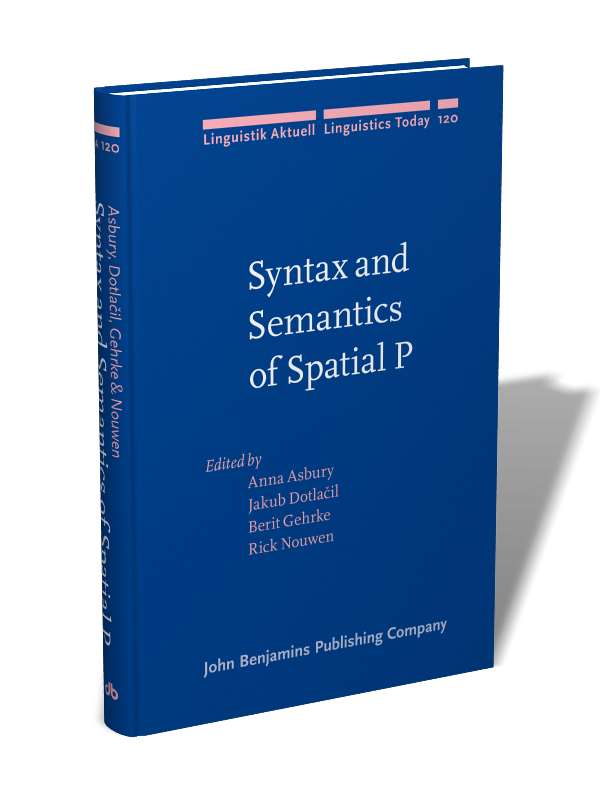
Syntax and Semantics of Spatial P
Editors

The category P belongs to a less studied area in theoretical linguistics, which has only recently attracted considerable attention. This volume brings together pioneering work on adpositions in spatial relations from different theoretical and cross-linguistic perspectives. The common theme in these contributions is the complex semantic and syntactic structure of PPs. Analyses are presented in several different frameworks and approaches, including generative syntax, optimality theoretic semantics and syntax, formal semantics, mathematical modeling, lexical syntax, and pragmatics. Among the languages featured in detail are English, German, Hebrew, Igbo, Italian, Japanese, and Persian. This volume will be of interest to students and researchers of formal semantics, syntax and language typology, as well as scholars with a more general interest in spatial cognition.
[Linguistik Aktuell/Linguistics Today, 120] 2008. vi, 416 pp.
Publishing status: Available
© John Benjamins Publishing Company




Table of Contents
-
Introduction: Syntax and semantics of spatial PAnna Asbury, Berit Gehrke, Henk van Riemsdijk and Joost Zwarts | pp. 1–32
-
Part I. The general architecture of spatial PPs
-
The fine structure of spatial expressionsMarcus Kracht | pp. 35–62
-
Projections of PPeter Svenonius | pp. 63–84
-
Priorities in the production of prepositionsJoost Zwarts | pp. 85–102
-
The grammar of complex particle phrases in EnglishBert Cappelle | pp. 103–145
-
Part II. Expressions of directionality
-
The correspondence between directionality and transitivitySander Lestrade | pp. 149–174
-
Pragmatic factors and variation in the expression of spatial goals: The case of into vs. inTatiana Nikitina | pp. 175–109
-
Complex PPs in ItalianRaffaella Folli | pp. 197–220
-
On the l-syntax of directionality/resultativity: The case of Germanic preverbsJaume Mateu | pp. 221–250
-
Part III. Locative PPs
-
The distribution and interpretation of adjunct locative PPsNaoko Tomioka | pp. 253–272
-
Aspect inside PLACE PPsChristina Tortora | pp. 273–301
-
Part IV. Silent Ps
-
The place of PLACE in PersianMarina Pantcheva | pp. 305–330
-
Why are they different? An exploration of Hebrew locative PPsIrena Botwinik-Rotem | pp. 331–364
-
Silent prepositions: Evidence from free relativesIvano Caponigro and Lisa Pearl | pp. 365–385
-
Part V. Grammaticalisation
-
The grammaticalization of prepositional markers in Igbo: The example of the verb root -nyé 'give'Chinedu Uchechukwu | pp. 398–407
-
Index of languages, dialects, and language families | p. 409
-
Index of authors | pp. 411–413
-
Index of subjects | pp. 415–416
“This splendid spectrum of studies offers a balanced and comprehensive perspective on the syntax and semantics of a surprisingly little-studied lexical category: the adposition. Focusing on the internal structure of spatial adpositional phrases, this volume brings together a variety of different ways of looking at the spatial PP, with interesting connections and valuable points of convergence between the individual case studies. The range of languages covered (including, besides the familiar suspects from Germanic and Romance, such typologically diverse languages as Hebrew, Igbo, Japanese, Persian, Russian, and Zapotec) is impressive and significant; so is the variety of analytical approaches, with cartography, the 'syntax of silence', corpus-based research, pragmatics, formal semantics, and optimality-theoretic work all being represented. One of the central themes pervading this collection of studies is the role and (language-internal as well as cross-linguistic) distribution of functional categories and functional structure in the syntax and semantics of spatial constructs -- including the question of whether adpositions (and particles) are themselves to be treated as lexical or functional elements, or as a mixed, hybrid category, or a mixed bag of heterogeneous elements. This timely and well-crafted volume, the fruit of a productive workshop organized by the editors, pays tribute to the important work that has been done in recent years on the structure of spatial Ps -- indispensable fare for all syntacticians and semanticists, because of the many ways in which the structures projected by spatial Ps inform the analysis of other major constituents. Spatial adpositions are at last getting the attention they deserve.”
Marcel den Dikken, City University of New York
Cited by
Cited by 15 other publications
Andrews, Avery D.
2017. Case: Oblique, Inherent, Semantic, Quirky. In The Wiley Blackwell Companion to Syntax, Second Edition, ► pp. 1 ff. 

BEAVERS, JOHN, BETH LEVIN & SHIAO WEI THAM
2010. The typology of motion expressions revisited. Journal of Linguistics 46:2 ► pp. 331 ff.
Burukina, Irina
2023. On the syntax of postpositional phrasesin Mari. Journal of Uralic Linguistics 2:2 ► pp. 158 ff.
Cappelle, Bert
2012. English is less rich in manner-of-motion verbs when translated from French. Across Languages and Cultures 13:2 ► pp. 173 ff.
Choueiri, Lina
2016. Locative prepositional phrases and inalienable PLACE in Lebanese Arabic*. In Perspectives on Arabic Linguistics XXVII [Studies in Arabic Linguistics, 3], ► pp. 3 ff.
De Mulder, Walter & Dejan Stosic
2009. Présentation. Langages n° 173:1 ► pp. 3 ff.
Fortis, Jean-Michel
2018. Anderson’s case grammar and the history of localism. In Substance-based Grammar – The (Ongoing) Work of John Anderson [Studies in Language Companion Series, 204], ► pp. 113 ff.
Gamerschlag, Thomas, Wiebke Petersen & Liane Ströbel
2013. Sitting, Standing, and Lying in Frames: A Frame-Based Approach to Posture Verbs. In Logic, Language, and Computation [Lecture Notes in Computer Science, 7758], ► pp. 73 ff.
Hagemeijer, Tjerk, Rita Gonçalves & Nélia Alexandre
2024. Spatial Locative Relativization in Three African Varieties of Portuguese: Unity in Diversity and Diversity in Unity. Languages 9:3 ► pp. 83 ff.
Höhn, Georg F. K.
2022. Preposition Allomorphy in Calabrian Greek (Greko) and Standard Modern Greek and Its Theoretical Implications. Languages 7:3 ► pp. 169 ff.
Korostenskiene, Julija
2017. On binding, lexical and superlexical prefixes, andsiin the Baltic verb. Canadian Journal of Linguistics/Revue canadienne de linguistique 62:3 ► pp. 449 ff.
Quaglia, Stefano
2021. Pattern replication and extraction from spatial PPs in Molise Slavic. Linguistic Variation 21:2 ► pp. 370 ff.
Rainsford, Thomas M.
2019. Chapter 14. De-prefixed spatial Ps in medieval French. In Romance Languages and Linguistic Theory 15 [Romance Languages and Linguistic Theory, 15], ► pp. 278 ff.
Real-Puigdollers, Cristina
Terzi, Arhonto
2017. Complex Spatial Expressions. In The Wiley Blackwell Companion to Syntax, Second Edition, ► pp. 1 ff.
This list is based on CrossRef data as of 16 april 2024. Please note that it may not be complete. Sources presented here have been supplied by the respective publishers. Any errors therein should be reported to them.
Subjects
Main BIC Subject
CFK: Grammar, syntax
Main BISAC Subject
LAN009000: LANGUAGE ARTS & DISCIPLINES / Linguistics / General