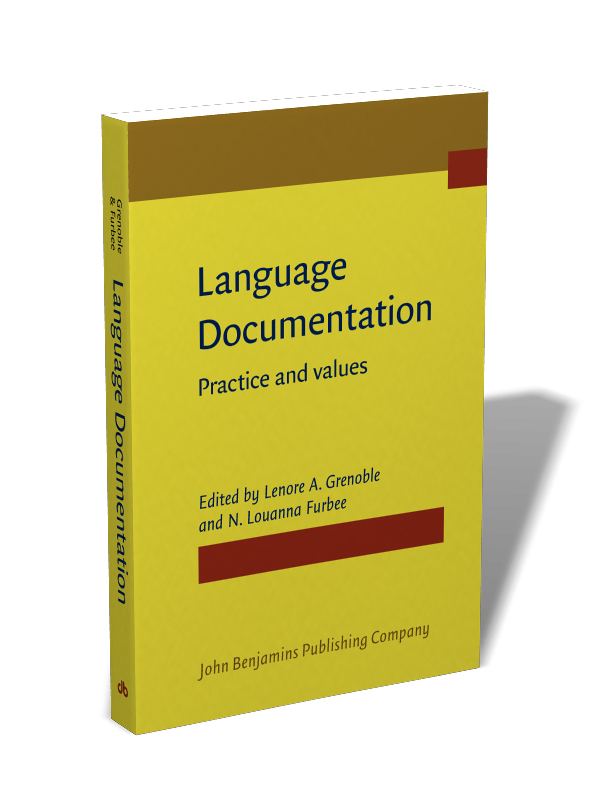
Language Documentation
Practice and values
Editors


Language documentation, also often called documentary linguistics, is a relatively new subfield in linguistics which has emerged in part as a response to the pressing need for collecting, describing, and archiving material on the increasing number of endangered languages. The present book details the most recent developments in this rapidly developing field with papers written by linguists primarily based in academic institutions in North America, although many conduct their fieldwork elsewhere. The articles in this volume — position papers and case studies — focus on some of the most critical issues in the field. These include (1) the nature of contributions to linguistic theory and method provided by documentary linguistics, including the content appropriate for documentation; (2) the impact and demands of technology in documentation; (3) matters of practice in collaborations among linguists and communities, and in the necessary training of students and community members to conduct documentation activities; and (4) the ethical issues involved in documentary linguistics.
[Not in series, 158] 2010. xviii, 340 pp.
Publishing status: Available
© John Benjamins Publishing Company




Table of Contents
-
Contributors | pp. ix–xii
-
PrefaceN. Louanna Furbee and Lenore A. Grenoble | pp. xiii–xviii
-
Part 1. Praxis and values
-
Language documentation: Theory and practiceN. Louanna Furbee | pp. 3–24
-
The linguist’s responsibilities to the community of speakers: Community-based researchKeren Rice | pp. 25–36
-
Language documentation: Whose ethics?Martha J. Macri | pp. 37–48
-
Part 2. Adequacy in documentation
-
Adequacy in documentationAnna Berge | pp. 51–66
-
Necessary and sufficient data collection: Lessons from Potawatomi legacy documentationLaura Buszard-Welcher | pp. 67–74
-
Documenting different genres of oral narrative in Cora (Uto-Aztecan)Verónica Vázquez Soto | pp. 75–88
-
Constructing adequate language documentation for multifaceted cross-linguistic data: A case study from the Virtual Center for Study of Language AcquisitionBarbara Lust, Suzanne Flynn, María Blume, Elaine Westbrooks and Theresa Tobin | pp. 89–108
-
Part 3. Documentation technology
-
Valuing technology: Finding the linguist’s place in a new technological universeJeff Good | pp. 111–132
-
Using the E-MELD School of Best Practices to create lasting digital documentationJessica Boynton, Steven Moran, Helen Aristar-Dry and Anthony Rodrigues Aristar | pp. 133–146
-
Sharing data in small and endangered languages: Cataloging and metadata, formats, and encodingsNicholas Thieberger and Michel Jacobson | pp. 147–158
-
Representing minority languages and cultures on the World Wide WebDavid Golumbia | pp. 159–170
-
Part 4. Models of successful collaborations
-
Beyond expertise: The role of the linguist in language revitalization programsDonna B. Gerdts | pp. 173–192
-
Models of successful collaborationArienne Dwyer | pp. 193–212
-
Working with language communities in unarchiving: Making the J. P. Harrington notes accessibleMartha J. Macri | pp. 213–220
-
Saving languages, saving lives: Tojolabal (Mayan) language revival within a health research NGOHermelindo Aguilar Méndez, Teresa López Méndez, Juan Méndez Vázquez, Maria Bertha Sántiz Pérez, Ramon Jiménez Jiménez, N. Louanna Furbee, Louanna del Socorro Guillén Rovelo and Robert A. Benfer | pp. 221–230
-
Language documentation in the Tohono O’odham communityColleen M. Fitzgerald | pp. 231–240
-
Documentation of pragmatics and metapragmatics: Language shift and pragmatic change in the Hmong language in WisconsinSusan M. Burt | pp. 241–252
-
Part 5. Training and careers in field linguistics
-
Training graduate students and community members for native language documentationJudith M. Maxwell | pp. 255–274
-
Native speakers as documenters: A student initiative at the University of Hawai‘i at ManoaFrances Ajo, Valérie Guérin, Ryoko Hattori and Laura C. Robinson | pp. 275–286
-
part 6. Conclusion
-
Language documentation and field linguistics: The state of the fieldLenore A. Grenoble | pp. 289–310
-
Selected online resources | pp. 311–314
-
Name index | pp. 315–336
-
General index | pp. 337–340
“Tant de bo aquest llibre, fet amb erudició i gran professionalitat, rebi l'atenció que es mereix fora de les fronteres dels Països Catalans i que la seva difusió arribi als filòlegs, romanistes, historiadors i altres estudiosos d'arreu del món interessats pels processos de codificació en general i per la llengua catalana en particular.”
Esther Gimeno Ugaldo, Universitat de Viena, in Llengua i ús, Número 47 (2010)
“The traditional language documentation apparatus of grammar, dictionary and text collection is no longer adequate for modern documentary linguistics. Today we want to preserve performance data as well, which entails additional community participation and heavy use of modern technology. Consequently, we encounter a multitude of new questions about intellectual property rights, adequate documentation, maximizing and standardizing the potential of technology, cooperation with revitalization efforts, and more. This book collects experts' and beginners' position papers and case studies covering the wide range of issues to be considered in the practice of today's documentary linguistics. It is an important textbook and reference guide for both seasoned and new practitioners from inside and outside of academia.”
David S. Rood, University of Colorado
“The contributors to this volume all share a sense of commitment and enthusiasm for the hard work of language documentation. Although they present may perspectives, their works all exhibit a preoccupation with the ethical practice of language documentation. As those persons labor to save languages that are endangered, or at least save a persistent and useable record of them, they are more concerned with the impact of the manner of their work than many of their predecessors have been.”
SirReadaLot.org, February 2011
“This rich collection addresses the many sides of language documentation and the issues they raise: the practical, methodological, intellectual, technological, cultural, interpersonal, and ethical. The contributions are varied but impressively coherent. As a group, the contributors bring a wealth of experience working with different languages and communities to the discussion, and expertise in all aspects of the documentation process. At the same time, certain threads run through the set, not the least of which is the value of collaboration between community members and linguists. Useful reading for anyone contemplating, embarking on or engaged in a language documentation project.”
Marianne Mithun, University of California, Santa Barbara
“This is an indispensable volume, that should become a classroom staple. A terrific collection of rich, readable, thought-provoking, and very practical chapters.”
Jane Hill, University of Arizona
“Here is abundance, coming at just the right time. The drive to document languages is a new pressing imperative for linguists, but a dense thicket of issues – intellectual, practical, social, ethical – threaten to frustrate their attempts to fulfill it. This book points out the hazards, and charts a path through them, combining focused position papers with the revealing experiences of dozens of practitioners.”
Nicholas Ostler, Foundation for Endangered Languages
“This is an exciting, wide-ranging exploration of the still-developing field of language documentation. It highlights the roles of technological advances and of ethical considerations in moving fieldwork from a solo enterprise to a multipurpose enterprise undertaken by and for diverse stakeholders, including both researchers and speaker communities. The collection is anchored by solid position papers, interspersed with illuminating case studies. Readers will come away from the volume fired by the possibilities of this field while also sobered by its intellectual and ethical challenges.”
Nancy Dorian, Bryn Mawr College
Cited by
Cited by 9 other publications
Avelino, Heriberto
2019. The ecology of variation and change in the context of language attrition. Language Ecology 3:1 ► pp. 28 ff. 

Dash, Niladri Sekhar & L. Ramamoorthy
2019. Corpus and Dialect Study. In Utility and Application of Language Corpora, ► pp. 139 ff.
Goddard, Cliff & Anna Wierzbicka
King, Alexander D.
2015. Add language documentation to any ethnographic project in six steps. Anthropology Today 31:4 ► pp. 8 ff.
Taylor-Adams, Allison
2023. Relational applied research: A model for re-balancing research relationships for equity in applied linguistics. Language Teaching 56:4 ► pp. 566 ff.
Voelkel, Svenja & Franziska Kretzschmar
2021. Introducing Linguistic Research,
Wilbur, Joshua & Michael Rießler
[no author supplied]
2011. PUBLICATIONS RECEIVED. Language in Society 40:4 ► pp. 535 ff.
[no author supplied]
This list is based on CrossRef data as of 19 april 2024. Please note that it may not be complete. Sources presented here have been supplied by the respective publishers. Any errors therein should be reported to them.
Subjects
Main BIC Subject
CBX: Language: history & general works
Main BISAC Subject
LAN009000: LANGUAGE ARTS & DISCIPLINES / Linguistics / General